Write
100 affirmations for creativity + 3 short audio scripts
100 grounded creativity affirmations for writing, art, music, experimentation, and critique. Choose your words and make three short personal audio scripts.
- Published
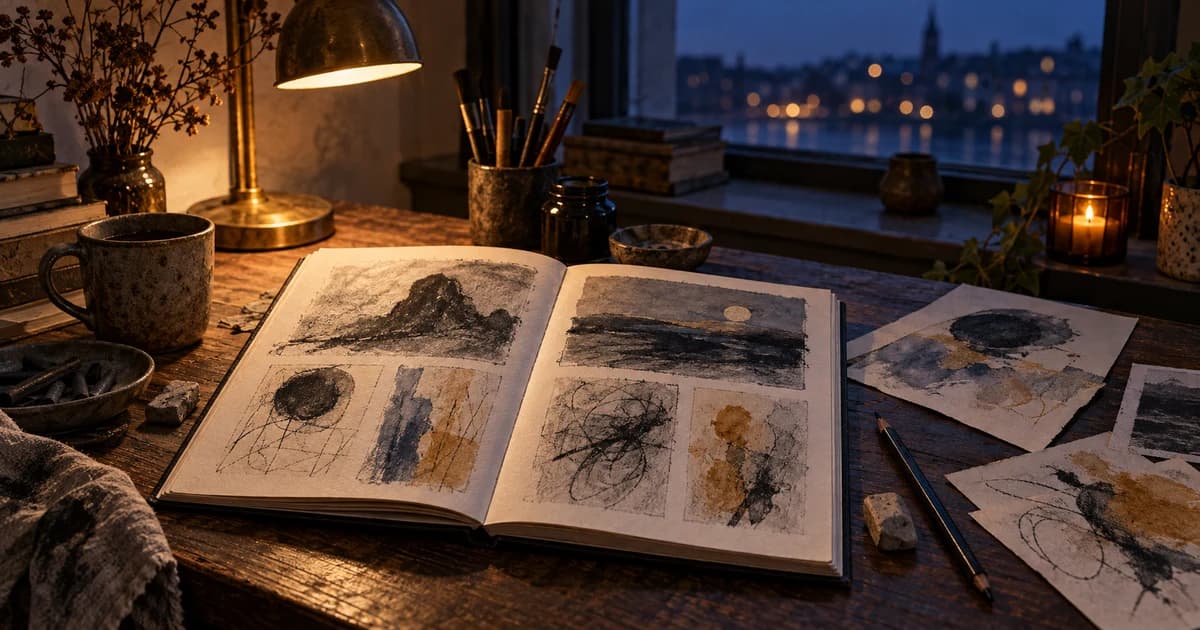
Creativity affirmations can be small reminders to look closely, try an experiment, express an observation, or return to a piece after critique. They do not create an idea for you or guarantee artistic success. Below are one hundred original lines for writing, visual art, music, design, and the decisions that connect them, plus three short scripts you can read or turn into private audio. Choose words that sound believable and pair them with a creative choice you can inspect. You do not need to feel inspired, claim a permanent identity, or listen to a recording before you are allowed to make something.
Start with words you can change.
Choose one purpose, edit every line, then carry the script into the free maker.
4 lines · 5 min test
Before one creative experiment. Keep only the lines that sound natural to you.
One spoken idea per line. Nothing is saved until you open the maker.
What creativity affirmations can do in a working session
A creativity affirmation is a short sentence you choose to accompany a creative decision. It can remind you to try another composition, describe a character more precisely, make a small sound experiment, or look at a problem from a different angle. It does not produce the drawing or solve the design. The useful connection is between a believable sentence and a creative action that you can actually take.
This guide uses creativity broadly: writing, visual art, music, design, craft, and everyday problem solving. You do not need a professional title before you can experiment. At the same time, saying that you are creative does not automatically give you a technique, a resource, or time away from other responsibilities. Your materials and working conditions still matter. A phrase should help you approach those conditions honestly rather than ask you to ignore them.
Choose the group that matches the decision in front of you. The purpose here is exploration and expression. If the main issue is beginning an overdue task or maintaining a schedule, the separate guides on procrastination and discipline may answer that need more directly. You can use a creative cue alongside an ordinary plan, but there is no requirement to turn every work session into a listening routine.
10 affirmations for noticing ideas
Ideas often begin as observations that have not yet become a project. A texture, a question, an overheard rhythm, or an unexpected contrast can be enough to collect. You do not need to judge its commercial value immediately.
Choose one line and pair it with a small record: a sketch, a sentence, a voice note, or a photograph you have permission to take. Collecting a detail leaves something to work with later. Repeating the line without observing anything is a different activity.
- I can notice a detail that deserves another look.
- An ordinary scene can offer a question worth exploring.
- I can collect an idea before deciding what it becomes.
- A texture, rhythm, or contrast can be a starting point.
- I let curiosity lead me to one concrete observation.
- I can look again at something I thought I understood.
- A small question can open an interesting direction.
- I do not need a complete project to save a useful detail.
- I can describe what caught my attention in my own words.
- My next idea can begin with careful looking.
10 affirmations for experimenting
An experiment asks what happens when you change one feature. Try another material, another point of view, another interval, or a different order. The experiment can be small enough that an unhelpful result does not consume the whole session.
Give the test a question before making it. For example, ask whether a wider margin changes the mood of a sketch. You then have a reason to compare two versions. An experiment does not need to become finished work to tell you something useful.
- I can try a version without promising to keep it.
- A small experiment can answer one creative question.
- I can change one feature and observe the difference.
- An unexpected result can give me useful information.
- I let a test stay smaller than the whole project.
- I can explore a material before asking it for a final result.
- A discarded version can clarify what I prefer.
- I can make room for an approach I have not tried.
- My first explanation does not have to be my last.
- I can let the experiment surprise me.
10 affirmations for writing
Writing offers choices at several scales: a verb, an image, a scene, a voice, or the order of information. These lines concern those choices rather than a promise to become a successful author. Pick the level you can inspect today.
Try writing the same observation in two voices or describing one room through a different character's attention. Compare what changes. The comparison can teach you about the text even if neither version belongs in the final piece.
- I can choose a precise word instead of a grand claim.
- This scene can reveal one detail I did not plan.
- I can listen for the rhythm of the sentence.
- A character can notice something different from what I notice.
- I can test another point of view on the same event.
- My own observation can give this page a specific image.
- I can let a question remain open while I draft the scene.
- A quieter sentence can sometimes carry more meaning.
- I can revise the voice without erasing what interests me.
- This piece can become clearer through concrete choices.
10 affirmations for visual art
A visual study can ask about shape, contrast, scale, color, or the relationship between objects. You do not have to settle your entire artistic identity before drawing a useful study. A modest question gives the page a workable purpose.
If a material is expensive or difficult to access, use a small scrap or a digital rough version to explore the relationship first. Constraints are real. They can shape a test without becoming a story that you should feel grateful for every limitation.
- I can study one shape before composing the whole image.
- A change in scale can reveal a new relationship.
- I can compare two colors without naming one perfect choice.
- A rough study can help me see what matters.
- I can notice the space around the subject.
- My marks can show an observation rather than prove a talent.
- I can try a quieter version of this composition.
- A material can suggest a direction I had not expected.
- I can choose what to leave out of the image.
- This study can be useful without becoming a finished artwork.
10 affirmations for music and sound
Sound experiments can be as small as changing a pause or answering a short phrase with another rhythm. These lines do not promise musical ability. They point toward listening, variation, and a choice that you can hear.
Keep the test comfortable in volume and duration. If you are practicing with other people, agree on the purpose of the passage. A creative cue should not become an instruction to keep repeating a loud section after someone has asked for a break.
- I can listen closely to the space between these sounds.
- A small rhythmic change can open another direction.
- I can try an answer to this short musical phrase.
- I let silence have a place in the experiment.
- A simple pattern can offer something worth developing.
- I can compare the feeling of two arrangements.
- My next take can test one clear musical choice.
- I can notice a useful texture without filling every space.
- I can stop the passage when I have heard enough to compare.
- Listening carefully is part of making this work.
10 affirmations for design and problem solving
Design includes understanding a need before inventing a solution. A different sketch may be interesting but still fail to answer the user's problem. These lines keep exploration connected to the people, conditions, and constraints that the work should serve.
Name the assumption your next version tests. Does a label make the choice clearer? Does a simpler arrangement reduce confusion? That question makes a creative alternative useful to inspect instead of requiring everyone to agree that it looks more imaginative.
- I can ask whose need this idea should answer.
- A new arrangement can be tested against a real problem.
- I can question an assumption before polishing the solution.
- A simpler choice can be a creative choice.
- I can make the next version easier to understand.
- Constraints can help me define a useful experiment.
- I can listen to feedback from the person using the work.
- An attractive idea still deserves a practical check.
- I can explore more than one response to this need.
- My design can become clearer through observation and revision.
10 affirmations for your own creative voice
Your creative voice can develop through choices you notice and repeat, not only through a declaration of originality. You may share influences with other people while seeing a subject differently. Comparison can provide information without deciding your worth.
Identify what you actually admire in another work: the pacing, the light, the restraint, or the arrangement. Study that feature, credit influences when appropriate, and make your own decisions. Admiration is not permission to copy protected text or present another person's work as yours.
- I can notice the choices that feel like mine.
- My influences can inform me without making every decision.
- I can appreciate another work and still explore my own question.
- A specific observation can make my expression more personal.
- I do not need to be unlike everyone to make something worthwhile.
- I can explain why this direction interests me.
- My creative preferences can change as I learn.
- I can credit an influence and choose my own response.
- A comparison can teach me without becoming a verdict.
- I can let my voice develop through actual work.
10 affirmations for revision
Revision asks what the work needs now. That might be a clearer image, fewer notes, a different sequence, or one removed element. It does not require you to dislike the earlier version or judge the entire project at once.
Save a copy before a large change. You can then compare the effect instead of relying on a vague memory. Keeping a version also makes experimentation less final: a useful part can return even if the new direction does not work.
- I can revise one relationship at a time.
- A saved version lets me compare a change fairly.
- I can remove an element without rejecting the whole piece.
- This work can become clearer through a smaller choice.
- I can name what the next revision should test.
- A change in order can reveal a different meaning.
- I can keep a useful part from an earlier version.
- The first idea does not have to carry every final decision.
- I can stop revising when the chosen question is answered.
- A clearer version can still keep the work's character.
10 affirmations for receiving critique
Feedback contains different kinds of information. Someone may report confusion, identify a technical issue, offer a preference, or make a judgment that does not help the work. You can ask which part they mean before deciding what to change.
Useful critique should be specific enough to act on. If a reader says a scene feels distant, ask where they lost connection. You can test that observation without accepting every suggestion or defending every choice in the same conversation.
- I can ask which detail led to this response.
- A specific observation can help me inspect the work.
- I can separate a preference from a practical problem.
- One comment does not describe the whole piece.
- I can take time before deciding what to revise.
- I can keep a choice that still serves the work.
- Feedback can offer a question rather than a command.
- I can request an example when a comment is vague.
- I can use a useful note without accepting a personal judgment.
- I can return to the work with one clear thing to test.
10 affirmations for sharing and finishing
Sharing a piece introduces an audience and a purpose. Decide what this version is for: a workshop, a portfolio, a gift, a prototype, or a conversation. The necessary level of finish depends on that purpose, not only on how nervous you feel.
Choose a boundary for the version you will share. Check permissions, legibility, file format, or another concrete requirement. A finished version can be a stage in a longer practice. You do not have to promise that no future version will improve it.
- I can define what this version is ready to do.
- A workshop draft can invite a useful conversation.
- I can check the practical details before sharing.
- This piece can reach its audience without answering every possible question.
- I can name a stopping point for this version.
- Sharing can give me information about how the work is received.
- I can choose an audience that fits this stage of the project.
- A finished version does not close every future possibility.
- I can let this piece leave my desk when its purpose is met.
- My next work can build on what this one taught me.
Choose a sentence that names a creative decision
Start with one situation rather than a general identity. If you are comparing two sketches, a line about scale or empty space is more useful than a claim that inspiration always flows. If you are revising a story, choose a line about what a character notices. You can make the sentence specific enough that its action is visible on the page.
Read the line aloud and check your first response. If it sounds like a demand, soften it. Replace a permanent claim with an available choice: you can try, compare, notice, ask, or revise. You are allowed to keep uncertainty in the sentence. Creative work often involves decisions whose value only becomes clear after you have made a version.
Choose three to eight lines for a first audio, or keep just one on paper. This is a manageable starting range, not a research-based dose. Remove lines that all do the same job. A script can include an observation, an experiment, a comparison, and an ending. It does not need ten different ways of telling you that you are brilliant.
Keep experimentation separate from evaluation
Consider making two small versions before choosing between them. In the first pass, ask what each possibility allows. In the second, compare them with the purpose of the project. This separation can give you something concrete to evaluate. It does not mean all ideas deserve equal time or that an unsuitable idea becomes useful if you keep affirming it.
For a visual piece, change only the scale of one element and keep the other relationships steady. For a story, try the same scene with a different point of view. For sound, move a pause rather than replacing the entire arrangement. A limited change makes the comparison easier to hear or see. It also protects the session from becoming a complete redesign every time you feel uncertain.
Record the question and what you noticed. A brief note such as 'the smaller title gave the illustration more room' is enough. That observation is the result of the test. Your mood while listening may be pleasant, but it is not evidence that the audio caused creative improvement. Keep the work and the listening preference as separate observations.
What the research does and does not establish
Tierney and Farmer's research on creative self-efficacy concerns beliefs about one's ability to produce creative outcomes in a workplace context. It is relevant to understanding creative self-belief, but it does not establish that this list, a hidden audio layer, or a particular frequency makes a person more creative. A measured relationship between beliefs and performance should not be turned into a guarantee about repeating a sentence.
Meichenbaum's 1975 study examined self-instructional training with a small group of college volunteers and comparison groups. Its intervention and divergent-thinking measures are different from a consumer affirmation loop. Its age, small groups, and specific procedure matter. It can help frame a question about self-directed language without serving as proof that any modern creativity audio works.
Cohen and Sherman's review of self-affirmation research discusses interventions involving important personal values and responses to threat. Values reflection is different from declaring a desirable trait. Wood, Perunovic, and Lee's research also shows why positive statements should not be assumed helpful for everyone. Keep a sentence believable, voluntary, and easy to change. The research supports careful distinctions, not a promise that you can bypass learning a craft.
Learn from a creative community without copying its words
The California College of the Arts publishes encouragement from its community about making art, critique, and personal expression. That page is an example of how affirming language appears in a creative setting. It is not a controlled test of the effects of audio. The one hundred lines here are original examples, not a reproduction of the college's list or a collection of protected author quotations.
When another person's sentence resonates, ask what need it names. Is it permission to experiment, a response to criticism, or a reminder to observe? Write your own specific cue around that need. If you quote another person's work in a public project, attribution and permission requirements still apply. An affirmation label does not remove copyright or make a line yours.
You can also ask a trusted peer for a concrete observation about your work. 'Which part held your attention?' is a more useful starting question than 'Am I creative?' The answer can lead to a testable choice. A community can offer perspective and practice opportunities; a recorded sentence cannot supply those relationships on its own.
A short script before a creative session
Use this before collecting a detail or making a small study. Decide what you will observe before listening. The passage has an ending so that preparing the audio does not use the time you intended to give to the work.
Change the third line to name your material if that helps. You might compare two pencil marks, describe a room, or test a rhythm. The script is a cue for that experiment. It does not require you to feel inspired before starting.
- I can notice a detail that deserves another look.
- A small experiment can answer one creative question.
- I can change one feature and observe the difference.
- This study can be useful without becoming a finished artwork.
A short script for exploring an idea
Use these lines when an idea feels interesting but incomplete. Write the question it opens, then make one version. Do not ask the script to predict whether the idea will succeed with an audience or become a finished project.
Keep a record of the version and the question. If the test gives no useful direction, you can stop or try another idea. Letting go of an experiment is compatible with creativity; it does not mean you failed to believe strongly enough.
- I can collect an idea before deciding what it becomes.
- I can try a version without promising to keep it.
- An unexpected result can give me useful information.
- I can let the experiment surprise me.
A short script after critique
This passage is for returning to the work after a feedback conversation. It does not instruct you to accept harmful treatment or every suggested revision. Pick one concrete observation that is relevant to the piece and leave personal judgments outside the script.
If a comment was vague, write a clarifying question before changing the work. If the feedback was useful, save the current version and make a small test. You can then compare rather than trying to resolve the whole conversation inside your head.
- I can ask which detail led to this response.
- I can separate a preference from a practical problem.
- I can take time before deciding what to revise.
- I can return to the work with one clear thing to test.
Record your own voice or keep a written cue
A written cue can be enough when you need quiet or want to keep the desk simple. If you prefer a recording, speak the approved lines into a phone recorder. Apple's Voice Memos guide documents that workflow on iPhone. Check the recorder and export options on your own device. Start without music so you can hear the wording and any unwanted noise.
Save the original take separately from the listening copy. You may want to change one word or a pause after trying the script. In Audacity, the documented Repeat function can repeat an approved passage. Keep the editable project as well as the exported file. A project and an MP3 serve different purposes; keeping only the finished file makes later repairs less flexible.
If you add music or a sound bed, use material you are permitted to use. A song you enjoy is not automatically licensed for a public audio project. For a first personal test, silence or a simple permitted background is sufficient. The background should leave the spoken lines comfortable to understand rather than require a louder listening level.
Make a private creativity audio in Supral
Paste a few lines, one per line, into Supral and choose a standard narrator. Preview pronunciation before creating the finished track, especially if the text includes a project name or an unusual word. The optional drafting assistant supplies suggestions for you to review. Approve the wording before generation and avoid unnecessary private details about collaborators or clients.
Standard-voice creation supports a free first test within the current limits. A free account stores creations in a private studio; guest delivery uses an email address. My Voice uses a consented voice sample and the corresponding voice credits to synthesize new narration. It is different from replaying a take you recorded yourself. Longer durations, pauses, and mix controls can solve particular production needs, but they do not establish a stronger psychological effect.
Choose a short duration with a clear ending. Listen to the whole finished passage once with understandable speech and check its words, levels, transitions, and ending. Your script remains yours to revise. If the recording takes attention away from the creative task, put it before the session or keep the written version. The best format is the one that fits the actual work you want to do.
Protect listening comfort and attention
The World Health Organization's safe-listening guidance concerns sound level, exposure time, and discomfort. There is no special loudness that makes these phrases more effective. Use a comfortable level and stop if you notice pain, ringing, or listening fatigue. A soft background does not make an otherwise loud headphone session safe.
Some creative work requires careful listening or attention to machinery. Do not play a spoken loop over music you need to evaluate, equipment you need to hear, or instructions you must follow. Put the brief cue before that work instead. Ask before playing your script through speakers in a shared studio. Other people do not have to hear your personal routine to support your project.
There is no need to leave the recording running overnight or repeat it until you reach a particular mood. Set a limit and observe whether it fits your session. If the audio is tiring, distracting, or simply unnecessary, stop. A creative practice can continue with ordinary materials, quiet, feedback, and time without a recorded affirmation at all.
Review the experiment rather than judging your identity
After a session, write one observation about the work: a clearer image, an arrangement worth testing, a question that remains open, or a version you decided not to keep. Separately note whether the phrase sounded natural. This keeps an audio preference from becoming a verdict about your creative ability.
You can try the same short cue over a few sessions if you want a fairer comparison. Keep the main wording steady and change one feature at a time. The number of sessions is a practical choice, not a validated protocol. Conditions differ between days, so a good or difficult session does not prove that the audio caused the outcome.
Look for a useful next decision, not a requirement to feel talented. You might keep one line, replace a broad statement with a more specific question, or remove the routine. A cue should remain easy to put down. If it becomes a way to postpone feedback, ignore a practical problem, or measure your worth, return to the work and the support it actually needs.
Sources and further reading
These references support the evidence and safe-listening limits discussed in this guide.
Frequently asked questions
Do creativity affirmations make you more creative?
That is not established for this list or an audio made from it. A sentence may be a useful personal cue for observing, experimenting, or revising, but the creative action still has to happen. The cited studies concern specific interventions and measures, not a guarantee for a consumer recording. Judge whether the words fit your session and keep learning the techniques your work requires.
What if I do not believe I am a creative person?
You do not need that identity statement to use a practical cue. Choose an available action such as looking closely, testing another composition, or describing one detail. A sentence can leave uncertainty in place. If a broad positive declaration makes you feel worse or starts an argument with yourself, soften it or stop using it. This exercise should not require proving a trait before you can make a study.
How many lines belong in a first creativity audio?
Three to eight lines are a manageable starting range, and the scripts here use four. These are practical choices for reviewing a short passage, not an evidence-based dose. Choose lines for one situation and remove duplicate ideas. Speech pace, pauses, and repetition affect the actual duration, so check the finished track instead of assuming that a particular word count produces an exact session length.
Can writers, artists, and musicians use the same script?
They can share a cue about observation or experimentation, but concrete wording often fits better. A writer can name a point of view, an artist a relationship of shapes, and a musician a rhythmic variation. Change the material while keeping the sentence believable. The script should support a decision in your medium rather than promise a general talent that applies automatically to every creative activity.
Should I listen while I am making the work?
Only if it is comfortable and compatible with the task. Spoken audio can interfere with writing, sound evaluation, instructions, or attention to equipment. A brief passage before the session may fit better. You can also use a written cue and keep the workspace quiet. Ask before using speakers in a shared room. Other people's listening needs matter even when your script contains positive words.
Can I use affirmations after harsh feedback?
You can use a line that helps separate a specific observation from a personal judgment. Ask what part of the work prompted the response and decide whether there is a useful test to make. You do not need to accept every comment, excuse harmful behavior, or immediately revise. If the situation needs a boundary or support from someone you trust, a recording does not replace that action.
Is my own voice better than a standard narrator?
There is no established universal winner for these phrases. A direct recording preserves the take you actually spoke; a standard narrator or personal synthesis profile reads approved text in another way. Choose the workflow you find comfortable and can revise. Check pronunciation clearly before adding background sound. You can keep the words on paper if recording or voice customization takes time away from the work.
How do I know whether to keep the practice?
Look for a modest fit: the words feel natural, the routine stays brief, and it accompanies a real creative decision. Keep observations about the work separate from your listening preference. A pleasant session does not prove a causal effect, and a difficult one does not mean you failed to affirm correctly. You can change one line, keep a written cue, or stop the routine without abandoning your creative practice.
Give a creative cue a voice
Choose a few believable lines, edit the details, and make a short personal audio before your next creative experiment.
Make my creativity audio