Understand
How long do subliminals take to work?
No study supports the subliminal timelines you see online. Spot false signs, choose what to count and try a 28-day test before you change your routine.
- Published
- Updated
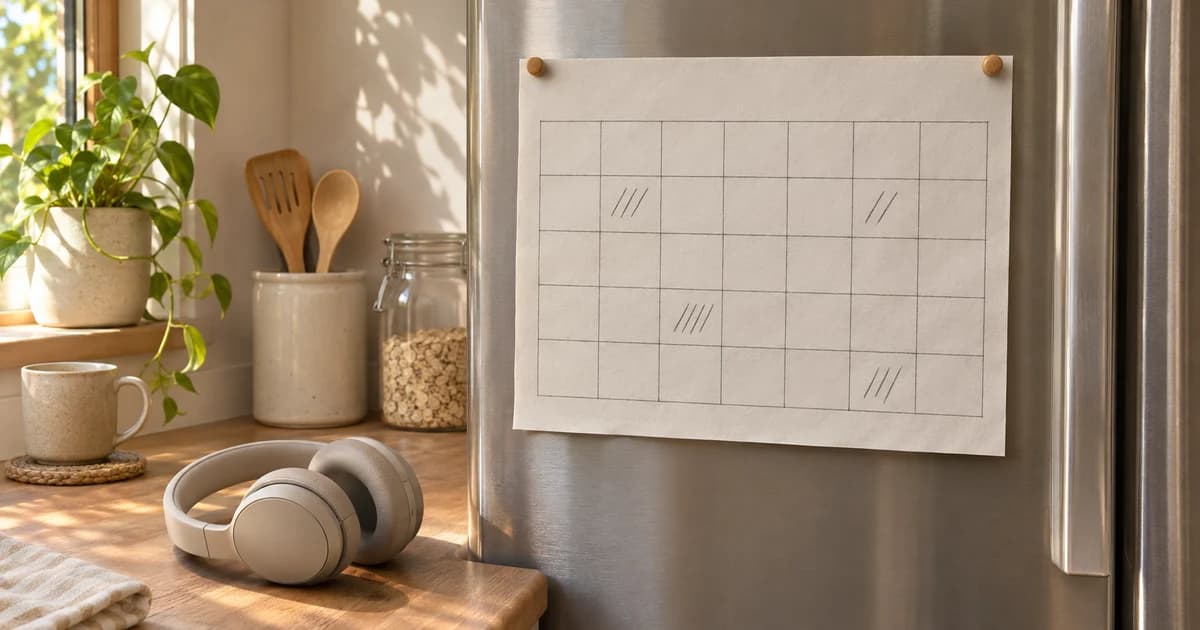
Tuesday, 7:42 a.m. You wait at the bus stop in the drizzle. It's day 16 of the same track. Your thumb types “how long do subliminals take to work” for the third time this week. Nobody can give you a real number: no study has timed how long subliminal self-help audio takes to work, and the week counts you keep seeing come from people selling tracks. In double-blind tests lasting about a month, the recordings failed to produce their advertised effects. Choose one action you can count, write down your starting count before you begin, review it on day 14 and decide on day 28 whether to keep the routine.
Start with words you can change.
Edit every line, then carry the script into the free maker.
9 lines · 5 min test
Answer your messages today. Before your chosen inbox check, when you keep postponing ordinary replies. Keep only the lines that sound natural to you.
One spoken idea per line. Nothing is saved until you open the maker.
Write the result before you press Play
Choose one action you want to do more often. “Answer the messages I keep putting off, on the same day” gives you something to count. “Become my best self” leaves you staring at the calendar. Open a note and write what happened over the last seven days, before changing your routine. To turn that action into a response you can practice, pair one trigger with one replacement line.
Review your count on day 14 and day 28; these are practical check-in dates, not scientifically established deadlines. Between them, keep the same action and a track whose words you can read. Record what you actually do when the chance comes up.
Make a short track for the replies you keep postponing, with one affirmation per line, ready for your next inbox check.
Where “three days” and “two to four weeks” come from
A comment says “three days.” A sales page says “two to four weeks.” Neither tells you what was counted, how the listener started or what else changed. Someone who sent a difficult text on Thursday may call it a result; someone waiting for a new face may use the same word. Those clocks aren't measuring the same thing.
Comments also leave out the quiet endings. A person who closes the tab after a month may never post an update. Ten excited replies cannot tell you how many people tried the track or what happened to them.
Ask for the starting point, the action and the comparison. “I replied to four of six messages this week, up from two of six” gives you something to discuss. “Results came fast” gives you an adjective.
What the studies actually put on the clock
Greenwald, Spangenberg, Pratkanis and Eskenazi's 1991 study tested memory and self-esteem tapes with 237 participants over a month, crossing the labels with the actual content. The promised effects did not appear; some listeners nevertheless believed they had improved in the area named on the label. Put your action and starting count in writing before the title starts writing your verdict for you.
Merikle and Skanes' 1992 study compared a commercial weight-loss tape, a placebo tape and a no-tape group, weighing participants weekly for five weeks. Average weight loss was approximately equivalent across all three groups. A change during listening needs a comparison: simply having pressed Play before something happened doesn't settle its cause.
For this specific claim, see what weight loss subliminals actually tested and make a short track for the moment before a decision.
In Ruch, Züst and Henke's 2016 laboratory study, masked faces paired with job titles influenced decisions about income on a screen 15 or 25 minutes later, a long way from “results in three weeks.”
The famous “66 days” from Lally and colleagues' 2010 study is the median of estimates ranging from 18 to 254 days for a simple repeated action to become nearly automatic: a habit, not an audio. For the minutes you spend listening each day, choose a session length that fits your routine.
Your notes won't tell you whether the audio, practice or expectation made the difference. They'll tell you whether you did the thing you set out to do, which is what you wanted to know. For the wider evidence behind the word “subliminal,” read what subliminal studies have actually tested.
Dreams, tingles and other unreliable “signs”
Once you start looking, an ordinary Tuesday can become a detective story. A dream supplies a clue; the microwave clock supplies another. Keep those observations out of your action count. They tell you nothing about whether you answered the message you meant to answer.
Feeling encouraged is pleasant. Enjoy it without making it the entry requirement for doing something useful. You can send a clear reply on a thoroughly unremarkable afternoon.
Dreams about your goal
- More ordinary explanation
- A topic already on your mind
- What you do
- Check your waking actions.
Tingling
- More ordinary explanation
- Position, pressure or focused attention
- What you do
- Change position; skip the interpretation.
Headache or fatigue called a “flush”
- More ordinary explanation
- Discomfort or tiredness, never a detox signal
- What you do
- Lower the volume or stop; rest.
Repeating numbers
- More ordinary explanation
- A pattern you're watching for
- What you do
- Leave it out of your notes.
One unexpected compliment
- More ordinary explanation
- One person's response in one situation
- What you do
- Look for repeated actions you control.
“Something is shifting”
- More ordinary explanation
- Mood, anticipation or expectation
- What you do
- Name what you did and when.
The useful signs have a verb and a date
“I answered the dentist's callback before the office closed.” “I told my friend which train I'm taking instead of leaving the message until Sunday.” These are actions with an ending. You can find them again in a call log or a sent conversation when Friday's memory gets hazy.
For this test, count ordinary messages that need a reply and arrive before your chosen evening cutoff. Leave spam and late-night arrivals outside it. Write the rule once: a brief answer that settles the question counts; opening the chat and thinking about it doesn't.
Include the opportunities. Two replies out of three messages and two replies out of twelve tell different stories. Note “Tuesday: replied by dinner, 1/1” or “Wednesday: left both until tomorrow, 0/2.” A day with no relevant messages gets a dash. For a request that needs more work, “I can check on Thursday” counts only when that honestly answers what the person asked.
If your target is different, keep the same shape. Count questions you ask during a weekly handover, or evenings you practice guitar after dinner. Pick one measure for the month. You can still notice that you feel calmer; let the dated actions decide whether the routine earns another week.
Your 28-day test: keep the weeks comparable
On day 0, look back through the previous seven days of messages. Your note might read “2 same-day replies out of 6 that needed one.” Save the script alongside that count. Choose one listening moment, such as before checking messages after lunch, and put the two review dates in your calendar.
At each review, compare the most recent seven days with that first week. Comparing seven days with fourteen would give the longer period an unfair head start. Keep the same cutoff and the same definition of a reply.
At day 28, “5/7” beside the original “2/6” is progress you can describe. Read the effort involved too: you may be replying more promptly but spending half an hour preparing each answer. Keep the part that makes answering easier. A two-word reply to a lunch plan should leave you time to eat lunch.
Day 0
- What you check
- One action; previous seven days' count, written down
- What you decide
- Save your starting point and script.
Day 3
- What you check
- Listening fits; comfortable volume; words feel right
- What you decide
- Fix friction before continuing.
Day 14
- What you check
- Latest week's action count; listening moment still fits
- What you decide
- Keep going or adjust one obstacle.
Day 28
- What you check
- Latest week versus starting week; effort involved
- What you decide
- Keep it, change one thing or stop.
Why twelve rotating tracks leave you guessing
Monday is a confidence playlist. Wednesday adds a booster. Friday brings six new goals and a different background. At the end of the month, “it feels different” could refer to almost anything. You've changed the file, the target and the circumstances at once.
Keep a version name such as “Replies-v1” in your note. If a line irritates you on day 3, change that line and record the date. If your lunch break disappears, move the session and note that too. Your notes should show which version you actually used.
For a crowded playlist, organize multiple subliminals into separate moments. For a script trying to cover your whole life, choose how many affirmations belong in one track. If the voice disappears under the background, check playback volume and mix balance separately before adding another file.
Nothing has changed by day 28? Put the wallet away
Read the actual line you keep hearing. “I communicate effortlessly with everyone” asks for a personality transplant before lunch. “I can answer the question in front of me” leaves room for an ordinary reply. Change the words before spending money on another version of the same promise.
If you want another attempt, change one thing and give the next review a date. Try the rewritten line, or read it from a note without playing the track. If even opening the message feels like too much, make today's action smaller: read one request and decide when you can answer it.
You can also stop. An unused audio file can stay unused. Buying a booster because nothing happened only adds a purchase to your notes; check what boosters actually add before paying. For a broader review of the script and setup, use the subliminal troubleshooting checklist.
Eye color, height and facial shape have no countdown
A recording has no mechanism for changing your eye color, making you taller or reshaping your face. There is no result date to wait for with those goals. Changing the photo angle every Sunday won't turn the calendar into evidence.
Write about something within reach: “I can leave the mirror after brushing my teeth,” or “I can book the appointment I've been putting off.” Keep the target in what you do and how you speak to yourself. The mirror can stay a bathroom object instead of becoming a daily examination.
You can end the test before the calendar says so
Day 9 is a perfectly usable stopping point. Close the player, remove the listening reminder and keep the action if you still want it. Answering a friend's message can remain on your afternoon list after the audio leaves it. You can return to the words later, or leave the file archived.
Stop early if listening worsens your sleep or stress; if thoughts about your body or food are causing distress, talk with a qualified professional, because an audio cannot replace someone you can talk to.
A track with your words gives you something to check
With a track you found online and no script to read, you don't know what's being said, so when nothing changes you're left guessing why. With your own words in Supral, you can change the line that feels wrong and make a new track right away. A free account gives you tracks up to five minutes, and “AI draft” turns your goal into 12 lines you can edit until they sound like you. Before listening, check your finished track against your script to catch a missing word or awkward reading.
Nine lines for answering today's messages
Pick one ordinary message you've been avoiding: a lunch plan, a delivery question or a friend asking which evening works. Keep “today” if same-day replies are your target. Change a line that sounds unlike you before it becomes the sentence you keep hearing.
Choose the hour you want to check messages, then let that window end. A reply can be “Thursday works” or “I can't make it.” The goal is to finish a small conversation while there's still time to make the plan.
Paste these nine lines and make your first short track, one affirmation per line. To compare the voice and pace first, open “Personalize the mix” and choose “Test the mix”: the free 15-second preview reads an example phrase, uses no creation and doesn't read your script. Hear your own lines in the finished file.
- I can answer the message waiting for me today.
- I answer the question in the message.
- I know whether six o'clock works for me.
- I can say yes without adding a long explanation.
- I can say no kindly when I need to.
- I ask which detail they still need.
- I can send an ordinary, useful answer.
- I can reply while I still feel a little awkward.
- I give this conversation an answer today.
One reply before the bus arrives
Back at the stop, the bus number blurs through the drizzle. You close the search, open the unanswered message and type, “Yes, six works for me.”
Sources and further reading
These references support the evidence and safe-listening limits discussed in this guide.
Frequently asked questions
How long do subliminals take to work?
Nobody can give you a real number: no study has timed it, and the “two to four weeks” you keep seeing comes from people selling tracks. Give yourself 14 days for a first review and 28 to decide, counting one action you wrote down before starting.
How do you know if a subliminal is working?
Check something you do: reply to messages the same day, ask a question or begin the practice you planned. Compare equal periods and include the opportunities you had. Four replies out of six tells you more than feeling different after pressing Play.
What are the signs your subliminals are working?
Look for repeated actions connected to your chosen goal, with a date and a count. Dreams, repeating numbers and tingling aren't evidence of progress. A sent reply has a timestamp you can check at the end of the week.
Can subliminals work overnight or in three days?
You can take a useful action tonight, but that won't establish an overnight subliminal effect. At day 3, check whether the words fit and whether listening is comfortable. Keep counting the action instead of waiting for a sensation.
Do you have to listen to subliminals every day?
Choose a repeatable moment that fits the action you're practicing. A missed session can stay a missed session; carry on at the next opportunity. Note the gap so you remember what your week actually involved when you review it.
No subliminal results after two weeks: is that normal?
Two weeks isn't a pass-or-fail deadline. Read your starting note, compare the latest week's actions and check whether you had similar opportunities. If nothing moved, rewrite one awkward line or choose a smaller action, then decide whether you want to continue.
Are dreams a sign your subliminal is working?
A dream about the topic doesn't tell you whether the routine changed your waking actions. Leave it out of the action count. Check whether you actually answered the message or did the practice you chose.
Should you change subliminals if you get no results?
Start with the words and the action you expected, then change one thing you can name. Keep a version date in your notes. At day 28, you can also put the track away and continue with a written reminder.
Write the reply you want to stop postponing
Copy the nine lines, change the words to sound like you and make a short track. Save your starting count before your first listening session.
Make your same-day reply track