Understand
Does a subliminal for studying help you learn?
Play your study subliminal before you study, then leave room for recall. Make a three-to-five-minute track and try a session built around testing yourself.
- Published
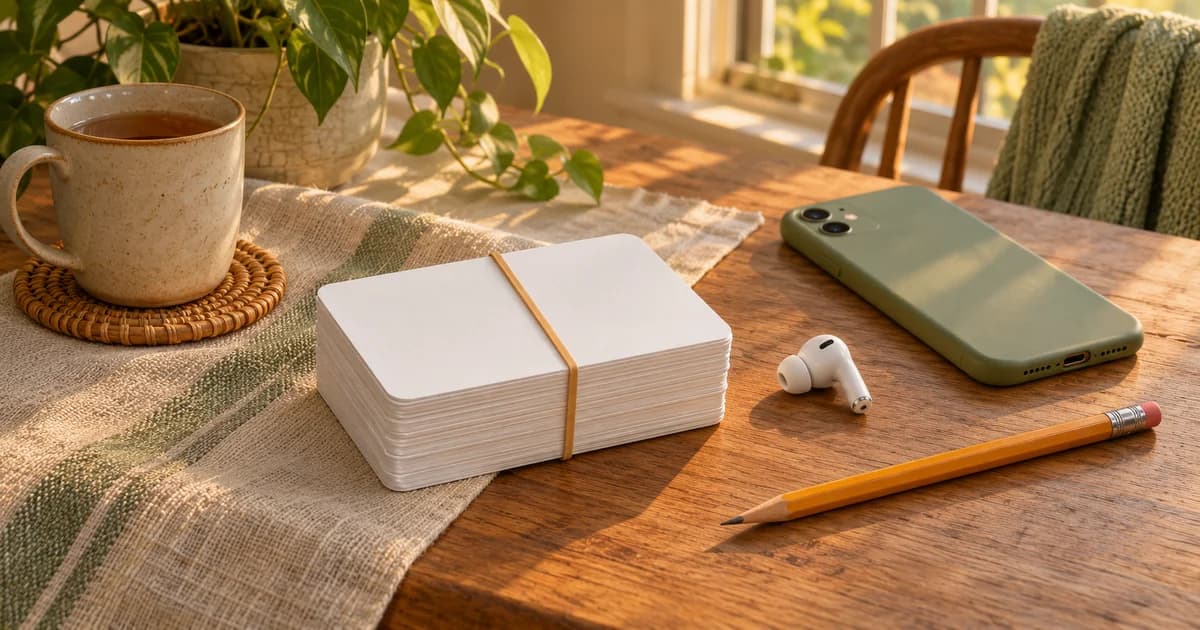
Sunday, 4:10 p.m., the kitchen table of your shared apartment in Columbus, Ohio. Your organic chemistry exam is Wednesday at 9 a.m. A rubber band holds 140 flashcards together, and a “study subliminal, photographic memory” video is already playing in one earbud. Hidden words won't put the course in your head, and a voice playing while you read takes attention the reading needs. Give your track three to five minutes before the session: sit down, put the phone aside and get to the first question, with silence or low instrumental music for the work that follows.
Start with words you can change.
Edit every line, then carry the script into the free maker.
9 lines · 5 min test
Sit down with your flashcards before checking anything else. Before your study session, when checking your phone keeps delaying the first card. Keep only the lines that sound natural to you.
One spoken idea per line. Nothing is saved until you open the maker.
The short answer: give your track the minutes before studying
Play your study track for three to five minutes before you begin, then switch to silence or low instrumental music while you read. The track can help you sit down; answering questions without looking and returning to them another day are what help you remember.
Make your three-to-five-minute study track now, with words about putting the phone aside and starting the first question.
Can you listen to subliminals while studying?
Not while you're reading or memorizing. In Salamé and Baddeley's 1982 experiments, people tried to recall digits they had seen while ignoring speech; the speech still disrupted recall, and similarity between the sounds of the words and digits affected the disruption. Being told to ignore words didn't keep those words out of the task.
Perham and Currie's 2014 reading study compared quiet, music without lyrics, liked music with lyrics and disliked music with lyrics. Both lyrical conditions disrupted comprehension equally and performed worse than quiet and non-lyrical music, which produced the same level of performance. For reading, liking the song didn't rescue it.
Choose silence first, or a low instrumental background if you prefer some sound: a voice, even a quiet one you notice, competes with the text. Neither study tested a subliminal; they show how background speech can interfere with verbal tasks.
One familiar instrumental track means fewer trips back to the playlist between questions. If you keep waiting for a chorus or following a melody instead of the sentence, silence is the easier choice.
“Photographic memory” and “learn 10x faster” sell a shortcut
Those titles offer a lovely bargain: keep the headphones on and the material will somehow stick. They also make ordinary effort feel suspicious. If an answer takes a second attempt, you might start searching for a stronger recording instead of looking at the step you missed.
In Greenwald and colleagues' 1991 double-blind tests, memory and self-esteem tapes were given labels that sometimes matched their hidden content and sometimes didn't. After a month, the claimed effects had not appeared; people's perceived improvement in a particular ability followed the label rather than the content. A memory label can make a recording feel convincing without delivering the advertised improvement.
The hidden layer doesn't carry your course into memory. A title about organic chemistry cannot explain why an electron pair moves, and feeling familiar with a reaction name is different from drawing its mechanism on blank paper. The blank paper is where the difference becomes visible.
What helps you remember after the page is closed
In Roediger and Karpicke's 2006 experiments, students studied prose and then either restudied it or tried recalling it without feedback. Restudying won on a test five minutes later, but earlier testing produced better retention after two days or one week. The comfortable feeling of another read was a poor forecast of what would remain later.
Dunlosky and colleagues' 2013 review assessed ten learning techniques and gave practice testing and distributed practice its highest usefulness ratings; rereading and highlighting received low ratings. In practice, that means answering with the material covered, checking the answer and coming back on another day. Your track has one job here: get you to that first covered answer.
For chemistry, an answer can be a drawing. A half-finished mechanism shows exactly where you stopped knowing what comes next. Tomorrow's practice can begin at that arrow instead of restarting an entire chapter because everything feels vaguely shaky.
The settings for a three-to-five-minute study track
Start with three to five minutes, while you're seated with the course open. Jenny and Guy are both English voices in Supral: Jenny is warm and steady; Guy is clear and grounded. One voice is plenty for a small set of lines.
Rain works as a steady background for the few minutes before you begin. At a natural pace, you can hear a whole sentence without the next one rushing in. A pause after “My phone can wait” sounds more like your own thought than a pep talk on fast-forward.
If one sentence sounds impatient when it repeats, change that sentence before changing the voice. A line like “I should already know this” can sneak into a study script wearing motivational clothing. It sounds much harsher on the fourth pass than on the first.
Duration
- Your choice
- 3–5 minutes
- Why
- Ends before you get restless.
Moment
- Your choice
- Seated; course open
- Why
- The first question is in sight.
Voice
- Your choice
- Jenny or Guy
- Why
- The same voice reads each line.
Pace
- Your choice
- Normal; short lines
- Why
- Each sentence ends before the next.
Background
- Your choice
- Rain
- Why
- No chorus to sing along with.
Ending
- Your choice
- Play once; repeat off
- Why
- Silence as you pick up the pen.
While studying
- Your choice
- Silence or low instrumental
- Why
- No voice competing with the text.
Write the words in three small movements
Use two or three lines to arrive: sitting in the chair, setting the phone aside, feeling your feet on the floor. “My phone can wait while I sit here” belongs to a real moment. A speech about becoming a brilliant student sends the recording far beyond the chair.
Next, give two or three lines to one task. “I have one reaction to work through” is small enough to mean something. You can picture one reaction on a page; “everything on the exam” is harder to face at once.
Finish with two or three lines that leave room for not knowing an answer yet. “An incomplete answer gives me a place to look” makes a gap bearable. The recording can end with that unfinished feeling still there; a practice question doesn't need a ceremony of perfect confidence.
For wording beyond this start-of-session script, choose concentration lines for the distraction you actually run into.
Leave promises about perfect recall out of the script
“I have a photographic memory,” “I retain everything after one read” and “I will get 100 percent” all turn the recording into a prediction. When you forget a definition, those predictions give you something else to measure yourself against. They also make another reread look more attractive than an honest attempt with the answer covered.
“I close the notebook and answer” is a more useful line. It asks for a visible move, and the answer can still be rough. You can keep an ambitious grade goal on your calendar without putting a guaranteed result into every repetition.
If the real delay happens before you even reach the desk, give the postponed task a smaller first step. That's a different snag from getting stuck halfway through a mechanism.
Can you learn a language in your sleep?
In Schreiner and Rasch's 2015 study, participants learned Dutch words while awake before hearing some of those words again during non-REM sleep. They later recalled the German translations of cued words better than uncued words; replaying the cues during active or passive wakefulness did not improve memory. The vocabulary was already learned before sleep began.
That is help for material you've worked on, not a way to acquire a new vocabulary list overnight. For a language course, the daytime job is still to connect a word with its meaning and try using it. Going to bed follows that work.
For overnight equipment, timers and the wider sleep research, decide whether leaving audio on fits your night.
Try one session this afternoon
Set aside enough time for two blocks of 25 to 30 minutes and a short break. Begin with a small pile you can actually attempt, with the answers hidden. Opening every topic at once makes it harder to tell what you worked on when the hour ends.
After each attempt, compare your answer with the course material. A missing condition or misplaced arrow gets a short note for the second block. The note should name the error: “forgot solvent,” for instance, says more than “bad at this.”
Keep the correction beside the question, then cover it for the next attempt. Otherwise the second block can turn into reading your own answer key. Tomorrow, the questions you missed get another chance alongside a few you answered today. A small written record makes the next session easier to choose without designing a whole new schedule.
Before the block
- What you do
- Play your 3–5-minute track once.
- At your table
- The kitchen chair
At the ending
- What you do
- Put the phone out of reach.
- At your table
- The single earbud
First 25–30 minutes
- What you do
- Answer first; check afterward.
- At your table
- Ten of the 140 flashcards
Short break
- What you do
- Stand up and get water.
- At your table
- The shared kitchen
Second 25–30 minutes
- What you do
- Try the missed questions again.
- At your table
- The loose rubber band
Before you finish
- What you do
- List errors to revisit tomorrow.
- At your table
- Wednesday, 9 a.m., on the calendar
When a study track isn't enough
If exam anxiety stops you from studying, or concentration has been difficult for weeks, talk with a doctor or your school or university health service. Keep this listening routine out of driving.
Why make a study track with your own words?
A “study subliminal” video asks you to trust what it hides; your own script lets you know the track is about starting the first question. In Supral, choose “Moments” then “When I procrastinate” and rewrite the lines for your study session. Tracks up to five minutes fit in a free account, so your three-to-five-minute version fits too. With your account, when a track ends you can add “One small action” and set a “Daily reminder” by email at the time of your next study session.
Nine lines before you check anything else
You sit down, but your thumb still wants to check the phone. These lines stay with that moment: feet on the floor, a card in your hand, the exam a few days away. There's no need to feel ready for all 140 cards to spend a few minutes with the first one.
Put these nine lines into your short study track, one affirmation per line. Use your own subject and exam time.
- I am here with the flashcards before checking anything else.
- My feet meet the kitchen floor.
- I feel a card's edge beneath my thumb.
- My back rests against the chair.
- Under my ribs, I have room for an easy breath.
- Wednesday at nine can stay on my calendar for now.
- This first card has my attention for a moment.
- An unfinished answer has room at my table.
- For these few minutes, I can let the rest wait.
When the track ends
The earbud rests beside the loose rubber band. On the kitchen table, the first card lies face up. Its answer is still underneath.
Sources and further reading
These references support the evidence and safe-listening limits discussed in this guide.
Frequently asked questions
Does a subliminal for studying work?
Yes, for getting started; no, for learning the material in your place. Try three to five minutes before the session, then test yourself and revisit missed questions another day: that's the part that helps you remember.
Can you listen to subliminals while studying?
Not during reading or memorizing: a voice, even a quiet one, competes with the text. Listen beforehand, then work in silence or with low instrumental music.
Can a subliminal give you a photographic memory?
No, an audio file won't give you a photographic memory. An answer written with your notes closed tells you what you actually remember and what needs another attempt tomorrow.
What music is best for studying and concentration?
No lyrics while you read; start with silence or low instrumental music. In Perham and Currie's study, music without lyrics and quiet produced comparable comprehension, while both liked and disliked lyrical music disrupted it.
How long should a study subliminal be?
Three to five minutes fits a short start-of-session routine. The file can end before the work begins, leaving you time for questions and corrections. For other listening situations, you can [fit the length to the moment](/blog/how-long-should-you-listen-to-subliminals).
Should you listen before, during or after studying?
Before, seated with your materials ready. Afterward, a brief note about what you missed gives tomorrow a starting point; replaying the track isn't necessary. For playback and script checks, you can [set up a routine around known words](/blog/how-to-use-subliminals).
Can you learn a language while sleeping?
No, sleep won't teach you new words. In Schreiner and Rasch's study, hearing words again during sleep helped recall of vocabulary already learned while awake.
Should you use a study subliminal the night before an exam?
Yes, before a short final review of your mistakes, with a clear stopping point. Once review ends, [give the evening a quiet ending](/blog/subliminal-for-sleep); for the doorway and difficult questions tomorrow, [choose words that fit the exam itself](/blog/exam-affirmations).
Give your next study session a starting track
Use the nine lines, make them sound like you and create your three-to-five-minute track for the moment before your first question.
Make your study track