Understand
Does a subliminal for sleep help you fall asleep?
Hidden words don't put you to sleep. You can make a quiet five-to-ten-minute bedtime track that stops on its own, with words that take the pressure off.
- Published
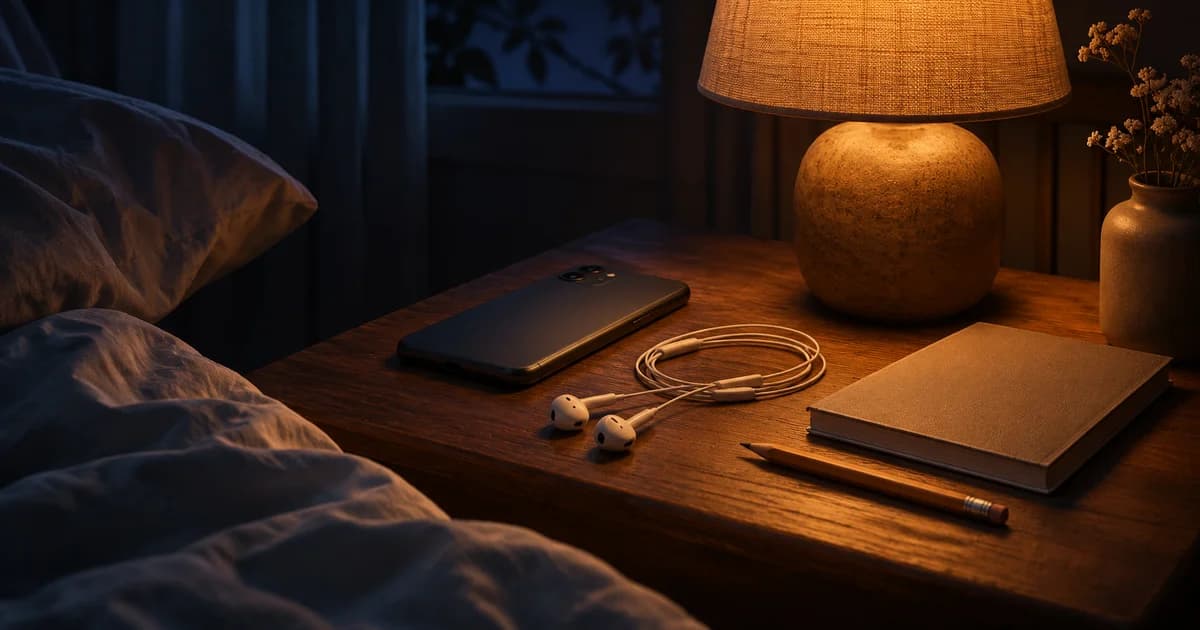
Thursday, 11:48 p.m., an apartment in Phoenix. The AC rattles. You type “subliminal to fall asleep fast,” and the top result is an eight-hour video with “delta waves” in the title. In your head, you are still giving tomorrow's 2 p.m. presentation, slide by slide. Hidden words don't put you to sleep; what can help is the calm sound and what your mind does while it plays. Choose a short, slow track that puts the day down, carries one peaceful scene and stops on its own.
Start with words you can change.
Edit every line, then carry the script into the free maker.
9 lines · 5 min test
Put tomorrow's presentation down for the night. Before bed, when you keep rehearsing tomorrow's presentation. Keep only the lines that sound natural to you.
One spoken idea per line. Nothing is saved until you open the maker.
Start with a track that gives your evening an ending
A sleep subliminal is usually a quiet affirmation track under music or background sound. For bedtime, give it five to ten minutes and one job: carry your attention away from unfinished work toward something undemanding. The useful choice begins with the sound you actually enjoy hearing in the dark.
Make a short bedtime track with words you choose. A handful of lines about putting the day down, followed by a few bodily details, gives the voice somewhere gentle to go. There is no need to fill the whole night just because the search result does.
A good first version has very little happening. One voice. One steady background. Enough space after a sentence that you aren't waiting for the next instruction. The file has an ending you know about before you turn off the light. For the rest of your setup, choose a listening routine built around known words and a clear purpose.
“Fall asleep in five minutes” is a title, not a stopwatch
The five-minute promise puts a deadline beside your pillow. A title saying “deep sleep” adds a second promise you cannot check by listening. A sudden drumbeat or a voice that sounds urgent matters more than either title.
In Greenwald and colleagues' 1991 double-blind tests, people received memory or self-esteem tapes whose labels and actual contents were crossed. After a month, the advertised improvements had not appeared; people's sense of which ability improved tended to follow the label, rather than the hidden content. A convincing name can do a lot of the selling.
Jespersen and colleagues' 2022 Cochrane review covered 13 studies with about 1,000 adults and found that music probably improved perceived sleep quality. Sessions lasted 25 to 60 minutes; objective measurements showed no clear improvement in time to fall asleep.
The sound matters, so choose it carefully. A steady texture is easier to stop following. A melody you keep humming or a dramatic swell gives your attention another little assignment.
Leave “I fall asleep instantly” out of the script
At one in the morning, “I fall asleep instantly” can sound like a status report your body keeps getting wrong. You hear the line, check whether it happened and discover that you are still awake. Now you're listening for a result as well as listening to a voice.
Use words that remain true before sleep arrives. “The work can stay on the desk” puts a boundary around an activity. A line about the weight of your hands gives you something to notice. Neither requires you to produce a particular feeling before the next sentence starts.
Cut sentences about tomorrow's brilliant performance too. Even a positive rehearsal keeps the meeting open. “Every answer comes easily to me” invites another run through the questions. The evening script needs less ambition than the daytime one; its last sentence should leave nothing to prepare.
If a line sounds borrowed from a motivational poster, rewrite it in words you would actually say. Ordinary language is easier company at midnight.
Put tomorrow on paper, then give your mind one scene
In Scullin and colleagues' 2018 sleep-laboratory study, 57 healthy young adults spent five minutes writing either a to-do list for the coming days or a list of completed activities. The to-do group fell asleep faster, and more specific future-task lists were associated with faster sleep onset. Before pressing play, write the actual loose ends: send the handout, check the room, bring the adapter. They now have somewhere to wait.
Harvey and Payne's 2002 experiment gave 41 people with insomnia imagery-distraction instructions, general distraction instructions or no instructions. Developing an engaging scene shortened reported time to fall asleep and reduced troubling thoughts compared with no instructions; the predicted worsening with general distraction was not supported. Give your track one quiet setting with a few details, rather than the vague demand to think about something else.
Neither study tested an audio track; they suggest what to do with your attention, and the recording can carry that choice.
A shaded porch works: a woven chair, a cool stone floor, leaves moving beyond the railing. Stay in that setting instead of traveling from a beach to a mountain to a glowing sky. A scene with fewer changes gives you fewer things to keep up with.
The settings for a quiet evening track
Choose five minutes for the first file. Ten is an option when you want more space, rather than more sentences. Jenny has a warm, steady delivery; Guy is clear and grounded. Pick the one whose voice feels least like someone asking you to pay attention.
Rain is a real background choice in the generator. Listen to the finished file once before bedtime, including the ending; a background you like for twenty seconds may feel busy after four minutes. The finished sound matters more than the name of the preset.
Duration
- Your choice
- 5–10 minutes
- Why
- You can hear it all first.
Voice
- Your choice
- Jenny or Guy
- Why
- One familiar voice.
Pace and space
- Your choice
- Slow; short lines
- Why
- A pause after each thought.
Background
- Your choice
- Steady rain
- Why
- No chorus to wait for.
Volume
- Your choice
- Comfortably low
- Why
- No loud voice in the dark.
Frequency
- Your choice
- Off to start
- Why
- No extra tone to follow.
Ending
- Your choice
- Play once; no next track
- Why
- Silence follows on its own.
Write the words in three small movements
First, put the day down in two or three lines. Name what is finished for tonight without reciting the whole list. “My notes are on the desk” works better here than a paragraph about every task you have left. The paper already holds the details.
Next, spend two or three lines on the body. Hands resting open, the contact of a heel with the sheet, the weight of a forearm: these are small, available sensations. “I feel my hands resting open” leaves more room than ordering every muscle to relax at once.
Finish with three or four lines in one peaceful scene. Describe the woven chair, the cool stone floor and leaves moving beyond the porch railing. Keep the verbs slow and the setting familiar enough that you aren't busy designing a vacation. A scene can be pleasant without becoming spectacular.
For more wording to choose from, pick a few bedtime affirmations that fit your evening. Eight or nine lines are plenty for this version; repeating a small set preserves the same mood instead of introducing a new goal each minute.
Press play in bed, with the screen face down
Have the file ready before you get under the sheet. Then turn out the light, start the track and put the phone face down. A low volume chosen beforehand saves you from spending the first two minutes balancing the sound in the dark; check your listening level and voice balance before bed.
A five- or ten-minute track stops on its own when you play it once, with repeat off and no next track queued. If you leave a loop or queue running, Supral's “Sleep timer” stops playback after 15, 30 or 60 minutes, fading the sound during the final 30 seconds; it is available with a free account.
If you wake at three, one short replay of the same file is enough audio for that attempt. Leave the loop off. For the separate question of leaving sound running overnight, check the playback setup and sleep-listening evidence.
Delta waves and 432 Hz don't select your sleep stage
A video cannot read your brain and send it into deep sleep on command. “Delta waves,” “432 Hz” and a dark blue thumbnail tell you how the track is presented, while your useful choice is a sound that stays unobtrusive. If the extra tone draws your attention, leave it off; compare binaural beats and solfeggio tones before adding a frequency layer.
Tonight, from the last search to the quiet room
At 11:48, close the search results instead of auditioning a fifth promise. Five minutes with a pen gives tomorrow's practical jobs a place outside your head. The list needs the missing adapter and the handout, not another draft of the opening speech.
The clock times below organize the evening; they aren't targets for falling asleep. Once the light is out, there is nothing useful to time. If your attention drifts away from the voice, the recording can keep going without your supervision.
11:48–11:53 p.m.
- What you do
- Write tomorrow's loose ends.
- In your scene
- Tomorrow's 2 p.m. slides.
11:53 p.m.
- What you do
- Put the phone face down.
- In your scene
- The eight-hour video thumbnail.
11:54 p.m.
- What you do
- Turn out the light.
- In your scene
- The rattling AC.
11:54–11:59 p.m.
- What you do
- Play the five-minute file once.
- In your scene
- The slides left for tomorrow.
At the ending
- What you do
- Let playback finish.
- In your scene
- The AC's hum.
If awake around 3 a.m.
- What you do
- One short replay, if wanted.
- In your scene
- The phone, screen still dark.
When a bedtime track isn't enough
If you sleep poorly at least three nights a week for three months, talk with a clinician; Riemann and colleagues' 2017 European guideline recommends cognitive behavioral therapy for insomnia as the first treatment for chronic insomnia. Keep a sleep track for bedtime, never for driving.
Why make a track with your own words?
With an eight-hour video, you may have no idea what is being said at one in the morning; with your own script, you know that no sentence orders you to fall asleep. In Supral, choose “Moments” then “Before sleep” as a starting point, and rewrite the lines for the evening you actually have. A free account lets you make a track up to five minutes long, enough for these nine lines with pauses. Your bedtime file can be short enough to hear all the way through before you use it.
Nine lines for putting tomorrow's presentation down
The opening lines leave the talk and its notes outside the bed. Four lines return to bodily sensations; the porch gives the final words somewhere quiet to land. Each sentence fits in one unhurried breath, with no report of how deeply you are sleeping.
Use these nine lines to make your short bedtime track, one affirmation per line. Read them aloud before generating and replace any word you wouldn't normally use. The sentences can stay plain. A familiar word asks less of you than a beautiful one you keep noticing.
- I leave tomorrow's presentation on the desk tonight.
- My slide notes are waiting beside the closed laptop.
- I feel the weight of my forearms on the sheet.
- My tongue rests softly behind my teeth.
- The backs of my knees feel warm against the bed.
- I have room across my ribs for an easy breath.
- I see leaf shadows drifting over the porch's stone floor.
- I sit in the woven chair beside the shaded railing.
- From this chair, I watch the leaves move slowly.
After the last line
The screen stays dark. Across the apartment, the closed laptop holds tomorrow's slides. The AC rattles once, then settles back into its hum.
Sources and further reading
These references support the evidence and safe-listening limits discussed in this guide.
Frequently asked questions
Does a subliminal for sleep work?
Yes, as a quiet bedtime sound; hidden messages have no established sleep-inducing effect. A short, slow track with familiar words gives you something gentle to follow as you put the day down.
Can a subliminal make you fall asleep fast?
Not on command. Write down tomorrow's tasks, play five quiet minutes and stop counting how long you have been awake.
Is there a subliminal for deep sleep?
No audio file can send you into deep sleep on command. Choose a steady sound without sudden changes that could wake you up.
Should you leave a sleep subliminal on all night?
No. Five to ten minutes is enough for this bedtime routine; with repeat off and no next track, the file stops on its own. You can leave the rest of the night quiet.
Is music or a voice better for falling asleep?
Music is the better starting point if a voice keeps drawing your attention to the words. You may prefer a slow voice when it gives your thoughts somewhere quiet to go. The useful choice is the sound you stop analyzing once you lie down.
How long should a subliminal for sleep be?
Five to ten minutes. That gives you time to put the day down and keeps the file short enough to hear all the way through before bedtime.
What should you put in a subliminal for sleep?
A few lines putting the day down, a few bodily sensations and one peaceful scene fit a bedtime track. You want short sentences that still make sense while you are awake. Tomorrow's achievements and commands to sleep instantly keep the script busy.
What if you wake up during the night?
One short replay, once, if you want it. Let the same file finish without a loop; if sleepless nights become frequent, talk with a clinician.
Give tonight's track your own words
Paste the nine lines, change what doesn't fit and make a five-minute track. Leave repeat off so the sound ends on its own.
Make your bedtime track